Professor Joe Majdalani serves as Francis Chair of Excellence and Professor of Aerospace Engineering at Auburn University. He previously served as the Auburn Alumni Engineering Council Endowed Professor and Department Chair (2013-2016) as well as the Jack D. Whitfield Professor and Hap Arnold Chair of Excellence in Advanced Propulsion at the University of Tennessee (2003-2013).
His academic career began as a Teaching Fellow at the University of Utah (1990) and then as an Assistant/Associate Professor at Marquette University (1997-2003).
Dr. Majdalani is known for his work on acoustic instability theory and vortex-driven rocket engine technology encompassing solid, liquid, and hybrid rocket applications.
He is an AIAA and ASME Fellow, Past Chair of the Hybrid Rockets (2015-2017) and Solid Rockets (2017-2019) Technical Committees, Southeast Region Deputy Director for Technical Activities (2021-present), Honors and Awards Director for the Greater Huntsville Section (2016-2020, 2021-present), AIAA Short Course Instructor, and Editorial Board Member of Physics of Fluids and Aerospace.
Dr. Majdalani’s research devotes itself to the computational modeling and optimization of solid, liquid, and hybrid rocket engines. His interests span rocket engine design and optimization, rocket internal ballistics, vorticity dynamics, computational mathematics, and singular perturbation theory.
His research activities since 1997 have materialized in over 330 publications in first-rate journals, book chapters, and conference proceedings, mostly in the field of rocket propulsion. These have attracted over 20,200 citations, thus placing Dr. Majdalani in the top 0.8% of the most cited aerospace engineering scholars worldwide (Stanford list, 2022).
His work on helical flow modeling has led to the discovery of new Trkalian and Beltramian families of solutions to describe cyclonic motions in self-cooled, multi-phase liquid and hybrid rocket engines. These have paved the way to understand and optimize a family of cyclonically-driven hybrid and liquid rocket engines.
His work on wave propagation has resulted in the development of a generalized-scaling technique in perturbation theory, and of a consistently compressible framework for capturing both vorticoacoustic and biglobal stability waves in simulated combustors.
These have led to a new framework for modeling combustion instability in rocket systems. Recently, his work on compressible gas motions has required the inception of a systematic procedure for modeling high speed flow problems. In fact, a total of eighteen dimensionless parameters have been newly identified in the course of his research investigations.
Throughout his academic career, Professor Majdalani has received several professional recognitions and accolades that include, but are not limited to:
§ 2024 Mark A. Spencer Creative Mentorship Award (Auburn University College of Engineering)
§ 2024 Wyld Propulsion Award (international award administered by 5 propulsion committees)
§ 2023 Von Kármán Lecture in Astronautics (distinguished international lecture in astronautics)
§ 2010–2024 twenty-two (22) AIAA best papers (advisory role): 14 regional (SEC RII) and 8 national
§ 2023 Senior Research Award for Excellence (Auburn University)
§ 2022 Auburn Book Author Award (Auburn University)
§ 2022, 2017 and 2012 Abe M. Zarem Educator Awards (twice in astronautics, once in aeronautics)
§ Five (5) AIAA Best Papers (AIAA Paper № 2022-1898, 2017-4779, 2014-4016, 2014-0006, 2004-4054)
§ 2021 Auburn University Outstanding Graduate Mentor Award (Auburn)
§ 2018 ASEE/AIAA J. Leland Atwood Award (international educator award)
§ 2016 AIAA Foundation Sustained Service Award
§ 2015 AIAA Foundation Faculty Advisor Award and Aerospace Engineering Outstanding Faculty
§ 2014 Konrad Dannenberg Educator of the Year Award (Greater Huntsville Section)
§ 2014 Best Paper in International Masters Division across 7 AIAA regions (AIAA Paper № 2014-0006)
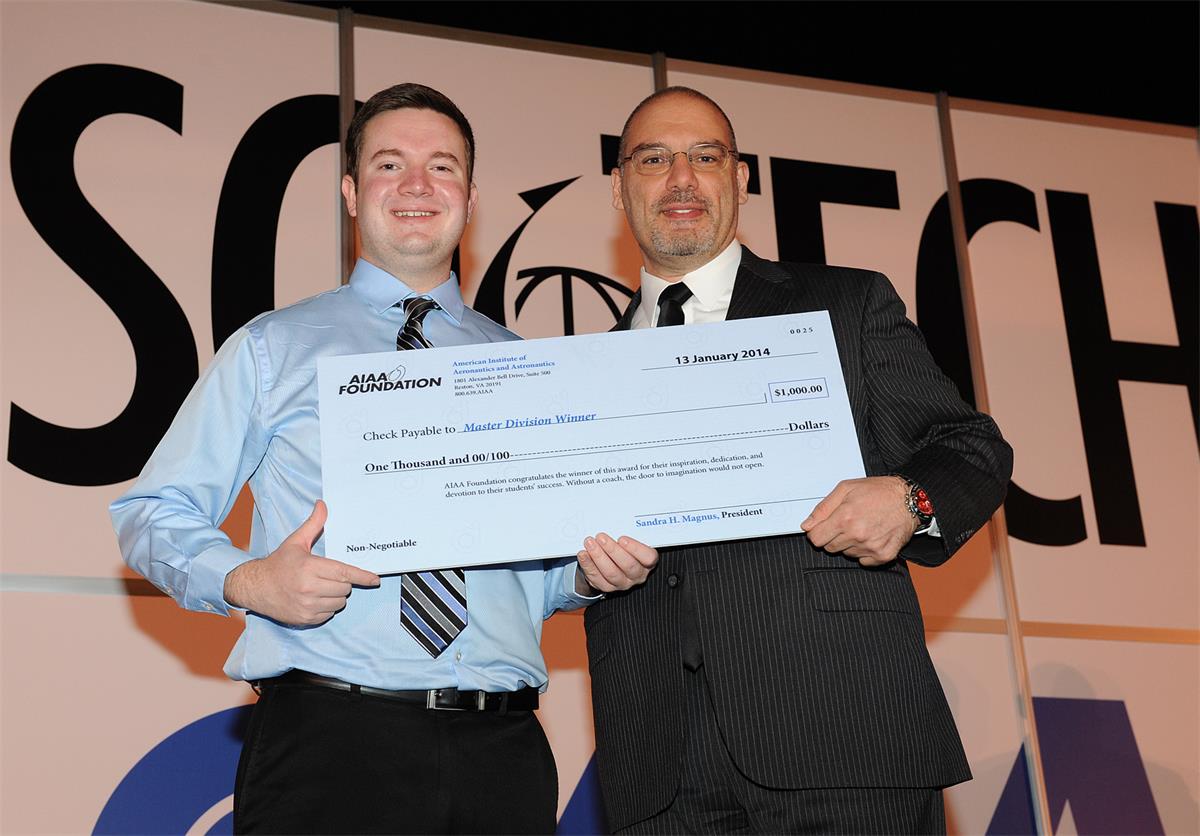
§ 2013 AIAA Special Award (AIAA Tennessee Section)
§ 2007 General Henry H. “Hap” Arnold Award (highest AIAA Tennessee Section award)
§ 2007 Ralph R. Teetor Educational Award (SAE International)
§ 2002–2004 NASA’s Faculty Research Infrastructure Award (twice recipient)
§ 2002–2003 NASA’s Higher Education Incentive Award
§ 2003 CAREER Award in the acoustics, mechanical systems, and controls division (NSF)
§ 1998–2000 Marquette University’s Outstanding Teaching Award (twice recipient)
§ 1997–1998 Marquette University’s College of Engineering Research Award.